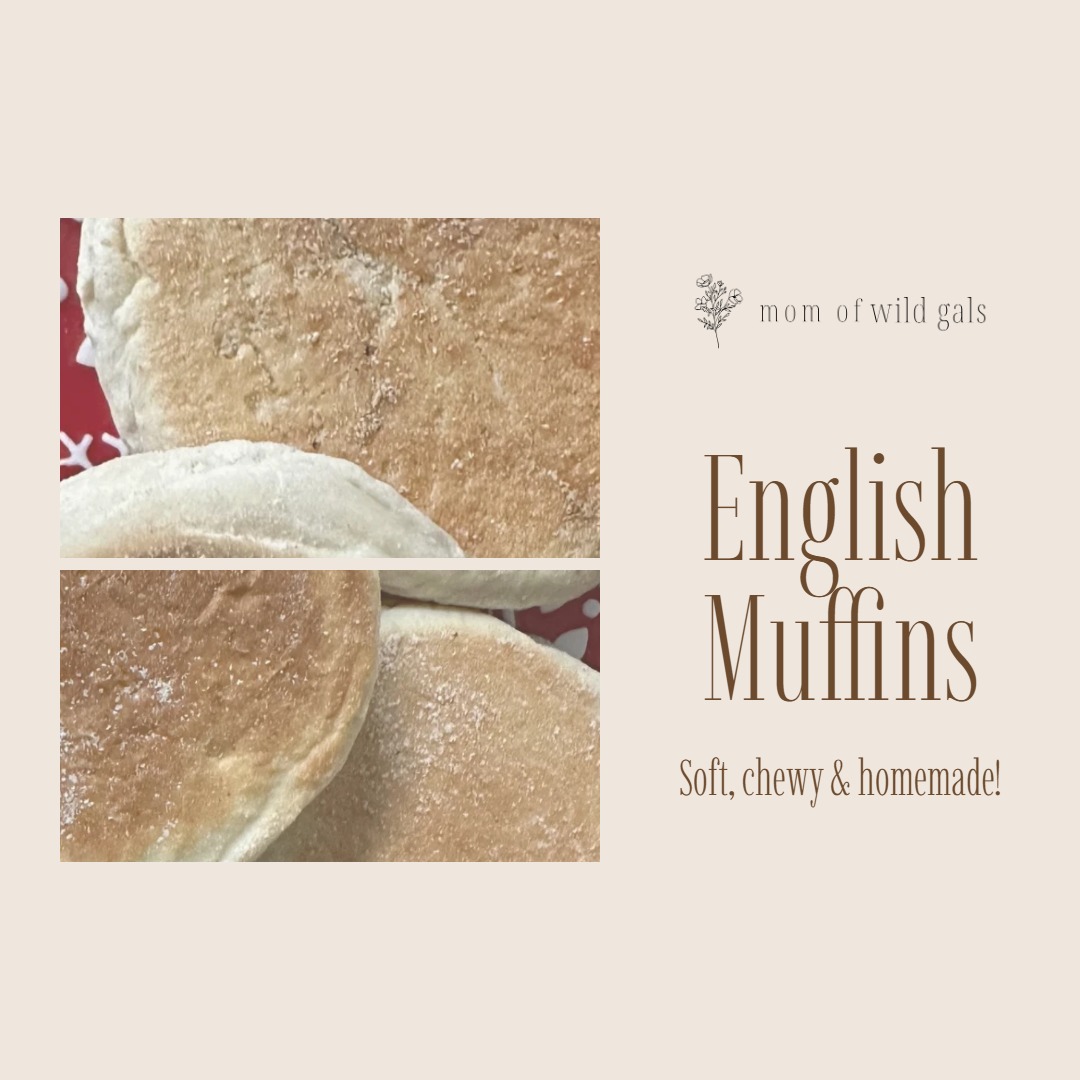
Soft, chewy homemade English muffins that taste so much better than store-bought.
There’s nothing quite like splitting open a warm, homemade English muffin and watching the butter melt into all those little nooks and crannies.
These homemade English muffins are cooked on a griddle until golden and then finished in the oven, so they’re perfectly cooked all the way through. They take a little time while the dough rises, but the steps are simple, and the girls love shaping the dough and dusting everything with cornmeal.
We eat them with butter and honey, peanut butter, as breakfast sandwiches, or as pizza muffins for an easy dinner. They disappear fast in our house!
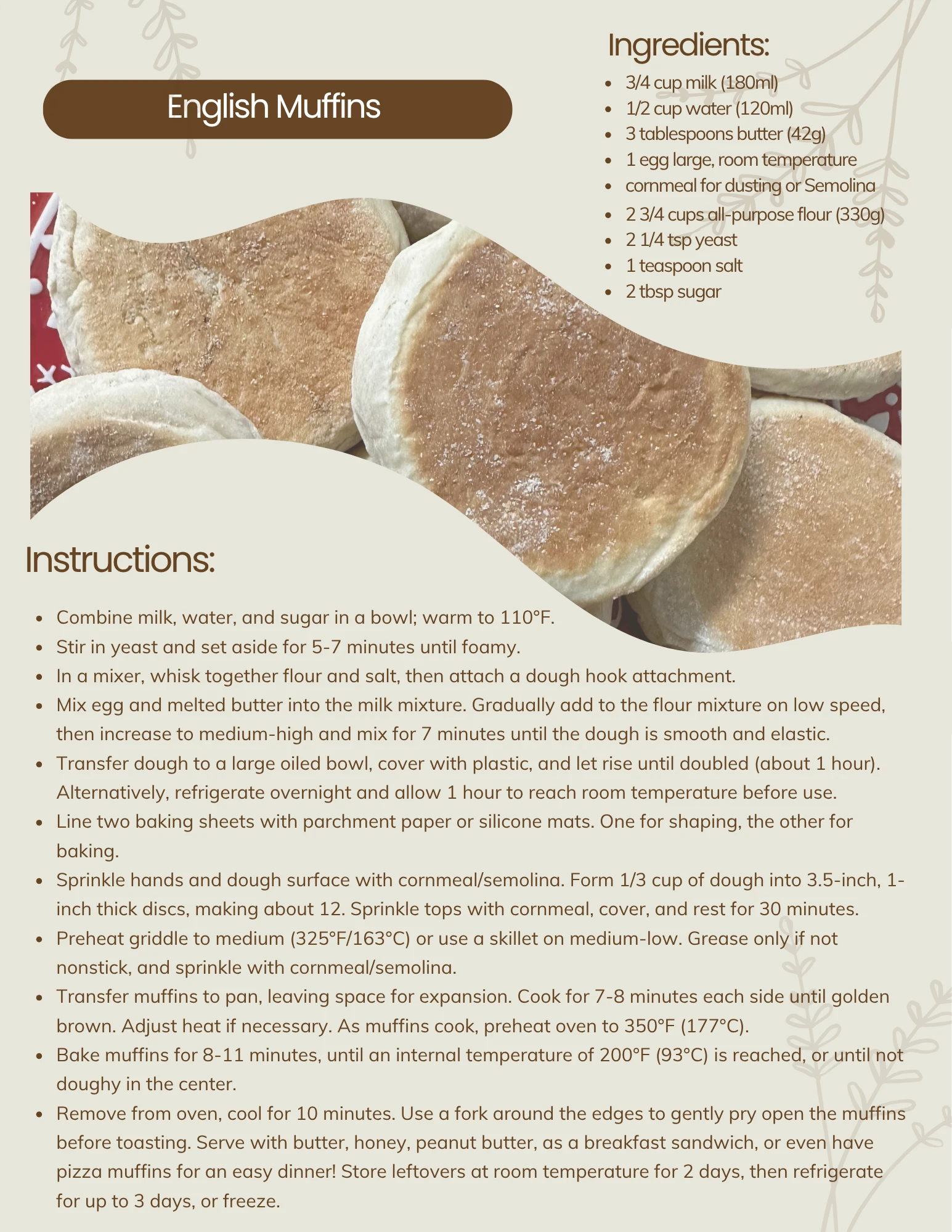
Homemade English Muffins
Prep Time: Approximately 30 minutes
Rise Time: About 1 hour, plus a 30-minute rest
Cook Time: 7–8 minutes per side on the griddle, then 8–11 minutes in the oven
Oven Temperature: 350°F (177°C)
Yield: About 12 English muffins
Ingredients
- ¾ cup milk (180 ml)
- ½ cup water (120 ml)
- 3 tablespoons butter (42 g), melted
- 1 large egg, room temperature
- Cornmeal or semolina, for dusting
- 2¾ cups all-purpose flour (330 g)
- 2¼ teaspoons yeast
- 1 teaspoon salt
- 2 tablespoons sugar
Directions
- Combine the milk, water, and sugar in a bowl and warm to 110°F.
- Stir in the yeast and set aside for 5–7 minutes, until foamy.
- In a stand mixer, whisk together the flour and salt, then attach the dough hook.
- Mix the egg and melted butter into the milk mixture. Gradually add it to the flour mixture on low speed, then increase to medium-high and mix for 7 minutes, until the dough is smooth and elastic.
- Transfer the dough to a large oiled bowl, cover with plastic wrap, and let it rise until doubled, about 1 hour. (Or refrigerate it overnight and allow 1 hour for it to come to room temperature before using.)
- Line two baking sheets with parchment paper or silicone mats: one for shaping and one for baking.
- Sprinkle your hands and the dough with cornmeal or semolina. Form ⅓ cup of dough at a time into discs about 3½ inches wide and 1 inch thick, making about 12. Sprinkle the tops with cornmeal, cover, and let them rest for 30 minutes.
- Preheat a griddle to medium (325°F/163°C) or use a skillet over medium-low heat. Grease it only if it isn’t nonstick, and sprinkle it with cornmeal or semolina.
- Transfer the muffins to the pan, leaving room for them to spread. Cook for 7–8 minutes per side, until golden brown, adjusting the heat if needed. While they cook, preheat the oven to 350°F (177°C).
- Bake the muffins for 8–11 minutes, until they reach an internal temperature of 200°F (93°C) or are no longer doughy in the center.
- Let them cool for 10 minutes. Use a fork around the edges to gently pry the muffins open before toasting.
- Store leftovers at room temperature for up to 2 days, then in the refrigerator for up to 3 more days, or freeze.
Turning English Muffins Into a Homeschool Lesson
Bread making is one of the best hands-on lessons there is. It’s part science experiment, part math lesson, and all delicious.
1. Kitchen Science: Watching Yeast Come Alive
Yeast is a living thing, and this recipe lets kids watch it work!
Ask your little learners:
- What happens when we add yeast to the warm milk and sugar?
- Why do you think the mixture gets foamy?
- Why does the dough get bigger while it rises?
- What do you think would happen if the milk were too hot or too cold?
For an easy experiment, mark the side of the bowl when the dough goes in, then check how high it has risen after an hour.
2. Kitchen Math: Measuring, Temperature & Time
- Use a thermometer to check that the milk mixture reaches 110°F.
- Compare cups and milliliters, or tablespoons and grams, using the measurements in the recipe.
- Practice fractions with ¾ cup, ½ cup, ⅓ cup, and 2¼ teaspoons.
- Set timers for each step and add up how long the whole recipe takes.
- Count the muffins as you shape them. Did you make 12?
3. Geometry: Measuring the Muffins
Grab a ruler and help your kids shape each disc about 3½ inches across and 1 inch thick. Talk about circles, diameter, and why the muffins spread a little as they cook.
4. Life Skills: Patience & Kitchen Safety
Bread teaches patience! Kids learn that good things take time while the dough rises and rests. Cooking on a griddle is also a great chance to talk about stove safety and let older children practice flipping with a grown-up close by.
5. History: Bread Around the World
English muffins have a long history as a breakfast bread. Talk about how families have made bread by hand for thousands of years, and look up other breads from around the world, like naan, tortillas, and baguettes. Maybe try another one next!
Breakfast Made Together
There’s something so satisfying about making bread from scratch with your kids. The flour-dusted counters, the excitement of checking on the dough, and the smell of muffins on the griddle make the morning feel special.
And the best part? Everyone gets to choose their favorite topping.
From our wild kitchen to yours, happy baking!
Mom of Wild Gals
Homeschool Subjects Covered: Science, Math, Geometry, History, and Practical Life Skills
Perfect For: Preschool, Kindergarten, and Elementary-Age Learners